
Feedback-based access schemes in CR networks: A reinforcement learning approach
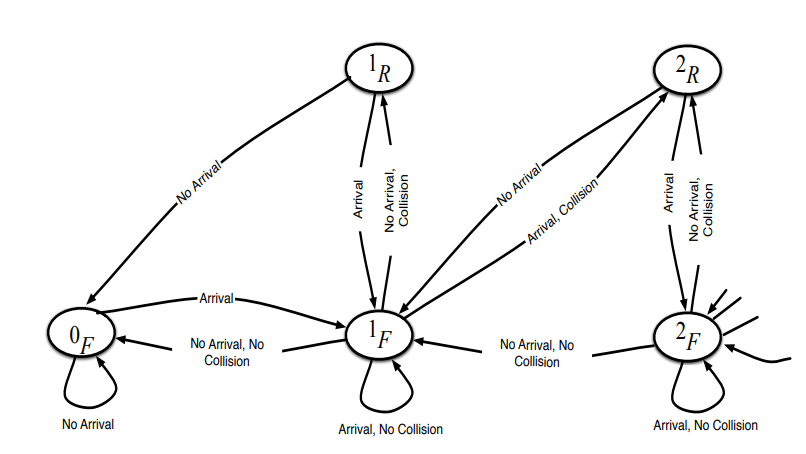
In this paper, we propose a Reinforcement Learning-based MAC layer protocol for cognitive radio networks, based on exploiting the feedback of the Primary User (PU). Our proposed model relies on two pillars, namely an infinite-state Partially Observable Markov Decision Process (POMDP) to model the system dynamics besides a queuing-theoretic model for the PU queue, where the states represent whether a packet is delivered or not from the PU's queue and the PU channel state. Based on the stability constraint for the primary user queue, the quality of service (QoS) for the PU is guaranteed. Towards
Overlapping multihop clustering for wireless sensor networks
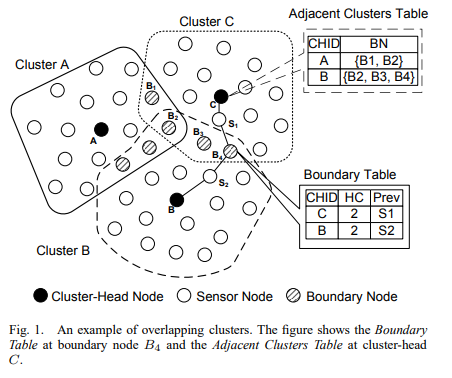
Clustering is a standard approach for achieving efficient and scalable performance in wireless sensor networks. Traditionally, clustering algorithms aim at generating a number of disjoint clusters that satisfy some criteria. In this paper, we formulate a novel clustering problem that aims at generating overlapping multihop clusters. Overlapping clusters are useful in many sensor network applications, including intercluster routing, node localization, and time synchronization protocols. We also propose a randomized, distributed multihop clustering algorithm (KOCA) for solving the overlapping
Collision Probability Computation for Road Intersections Based on Vehicle to Infrastructure Communication
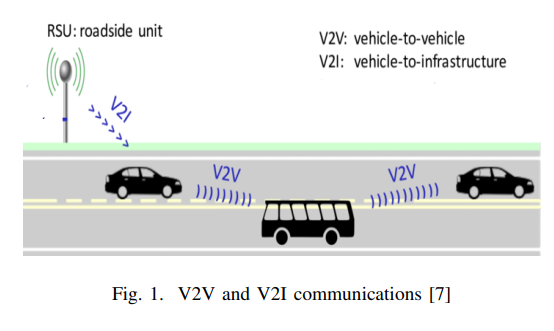
In recent years, many probability models proposed to calculate the collision probability for each vehicle and those models used in collision avoidance algorithms and intersection management algorithms. In this paper, we introduce a method to calculate the collision probability of vehicles at an urban intersection. The proposed model uses the current position, speed, acceleration, and turning direction then each vehicle shares its required information to the roadside unit (RSU) via the Vehicle to Infrastructures (V2I). RSU can predict each vehicle's path in intersections by using the received
A Review of Machine learning Use-Cases in Telecommunication Industry in the 5G Era
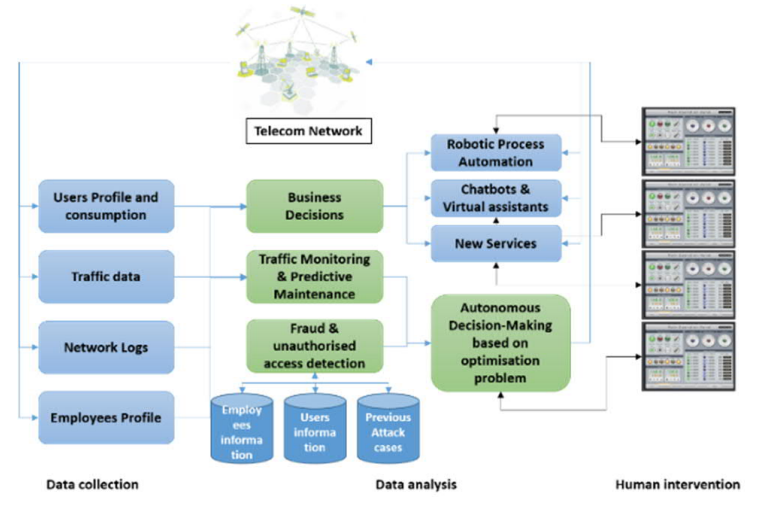
With the development of the 5G and Internet of things (IoT) applications, which lead to an enormous amount of data, the need for efficient data-driven algorithms has become crucial. Security concerns are therefore expected to be raised using state-of-the-art information technology (IT) as data may be vulnerable to remote attacks. As a result, this paper provides a high-level overview of machine-learning use-cases for data-driven, maintaining security, or easing telecommunications operating processes. It emphasizes the importance of analyzing the role of machine learning in the
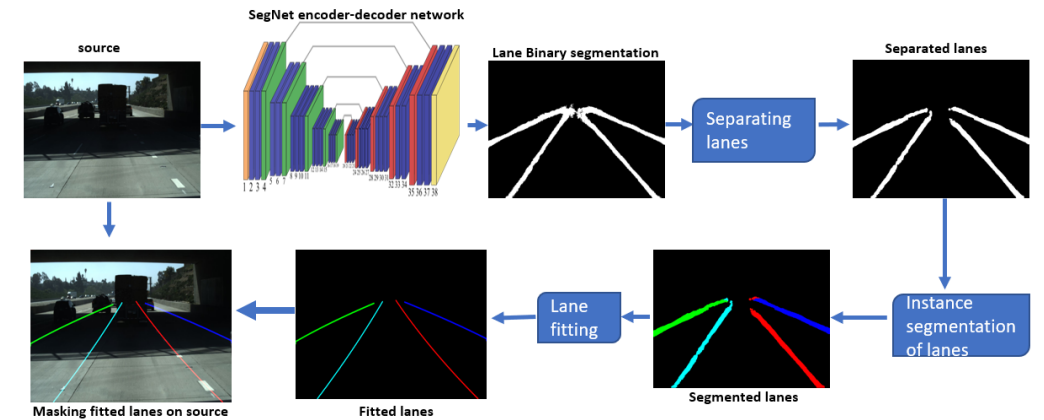
Real-Time Lane Instance Segmentation Using SegNet and Image Processing
The rising interest in assistive and autonomous driving systems throughout the past decade has led to an active research community in perception and scene interpretation problems like lane detection. Traditional lane detection methods rely on specialized, hand-tailored features which is slow and prone to scalability. Recent methods that rely on deep learning and trained on pixel-wise lane segmentation have achieved better results and are able to generalize to a broad range of road and weather conditions. However, practical algorithms must be computationally inexpensive due to limited resources
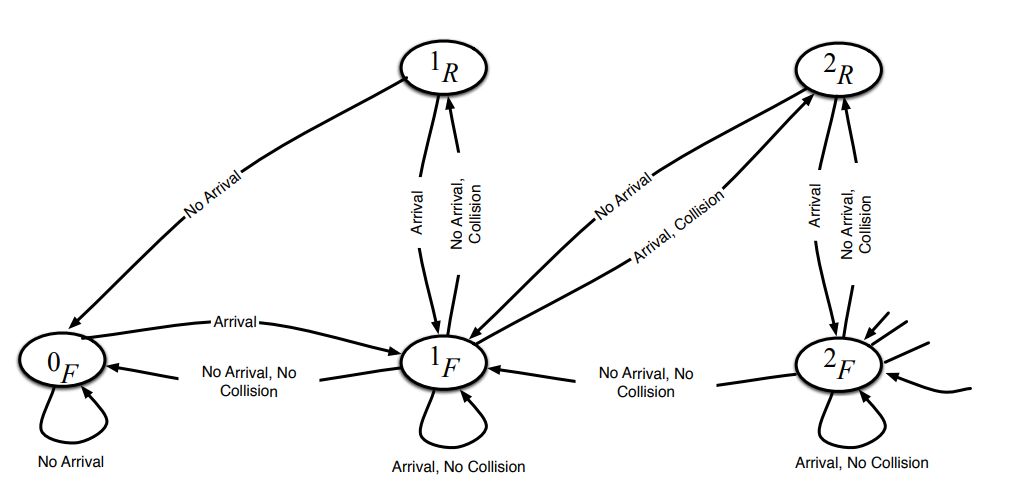
A reinforcement learning approach to ARQ feedback-based multiple access for cognitive radio networks
In this paper, we propose a reinforcement learning (RL) approach to design an access scheme for secondary users (SUs) in a cognitive radio (CR) network. In the proposed scheme, we introduce a deep Q-network to enable SUs to access the primary user (PU) channel based on their past experience and the history of the PU network's automatic repeat request (ARQ) feedback. In essence, SUs cooperate to avoid collisions with other SUs and, more importantly, with the PU network. Since SUs cannot observe the state of the PUs queues, they partially observe the system's state by listening to the PUs' ARQ

FCM-based approach for locating visible videowatermarks
The increased usage demand for digital multimedia has induced significant challenges regarding copyright protection, which is the copy control and proof of ownership. Digital watermarking serves as a solution to these kinds of problems. Among different types of digital watermarking, visible watermarking protects the copyrights effectively, since the approach not only prevents pirates but also visually proves the copyright of the broadcasted video. A visible watermark could be in any location on the frame (corner, center, diagonal, etc.). In addition, it could either completely or partially
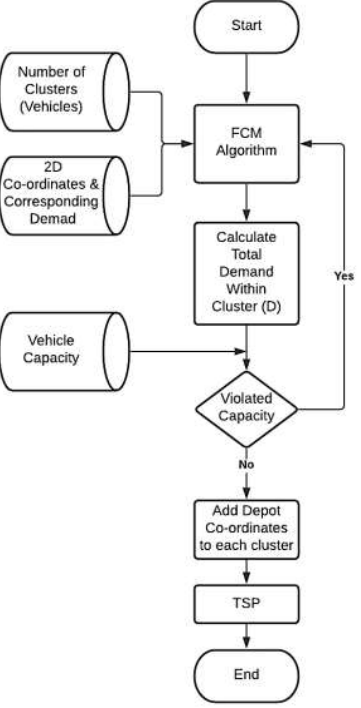
Modified fuzzy c-means clustering approach to solve the capacitated vehicle routing problem
Fuzzy C-Means clustering is among the most successful clustering techniques available in the literature. The capacitated vehicle routing problem (CVRP) is one of the most studied NP-hard problems. CVRP has attracted the attention of many researchers due to its importance within the supply chain management field. This study aims to develop a fuzzy c-means clustering heuristic to efficiently solve the CVRP with large numbers of customers by using cluster-first route-second method (CFRS). CFRS is a two-phase technique, where in the first phase customers are grouped into, and in the second phase
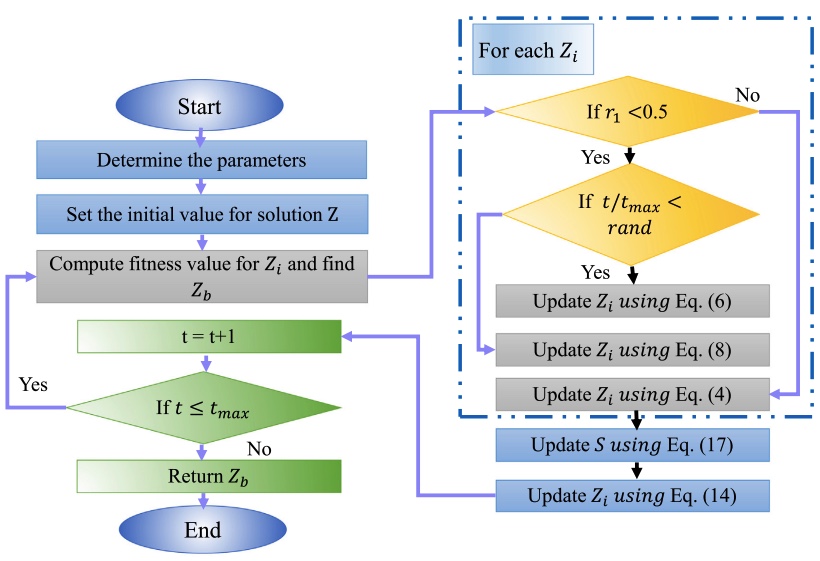
A Grunwald–Letnikov based Manta ray foraging optimizer for global optimization and image segmentation
This paper presents a modified version of Manta ray foraging optimizer (MRFO) algorithm to deal with global optimization and multilevel image segmentation problems. MRFO is a meta-heuristic technique that simulates the behaviors of manta rays to find the food. MRFO established its ability to find a suitable solution for a variant of optimization problems. However, by analyzing its behaviors during the optimization process, it is observed that its exploitation ability is less than exploration ability, which makes MRFO more sensitive to attractive to a local point. Therefore, we enhanced MRFO by
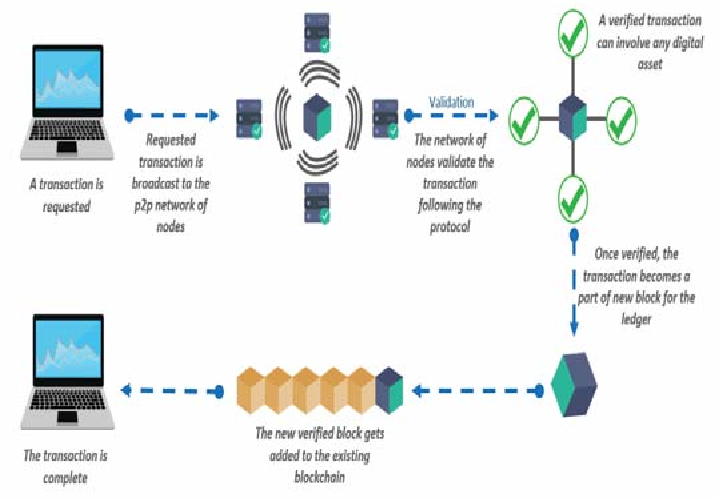
IoT Systems Internal Mapping using RTT with the integration of Blockchain technology
The degree to which innovators adopt Blockchain as a tool to create relevant and useful business solutions will determine how fast and far the platform moves into our daily lives. There are limitless opportunities for technology to define and shape future innovation. In a world dominated by digital technology, IoT plays a prominent role in our lives. It has created an ecosystem that links many systems to give smart performances in every task. The proliferation of the IoT has created a new evolution of cell phones, home and other embedded applications that are all connected to the internet