
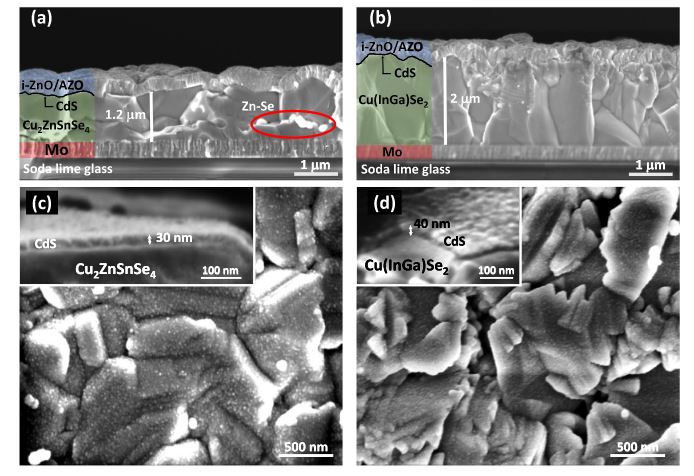
Impact of the Cd2+ treatment on the electrical properties of Cu2ZnSnSe4 and Cu(In,Ga)Se2 solar cells
Modification of the absorber surface properties by Cd2+ treatment (Cd2+ partial electrolyte) results in the following: formation of Cd(OH)2 on the absorber surface, deposition of thinner chemical bath-deposited CdS buffer layer, and a smaller space charge region. The impact on electrical performances is as follows: decrease of the series resistance (RS), increase of the fill factor, increase of the efficiency (η), and reduction of the crossover between the dark and light current density-voltage curvesThe present contribution aims at determining the impact of modifying the properties of the
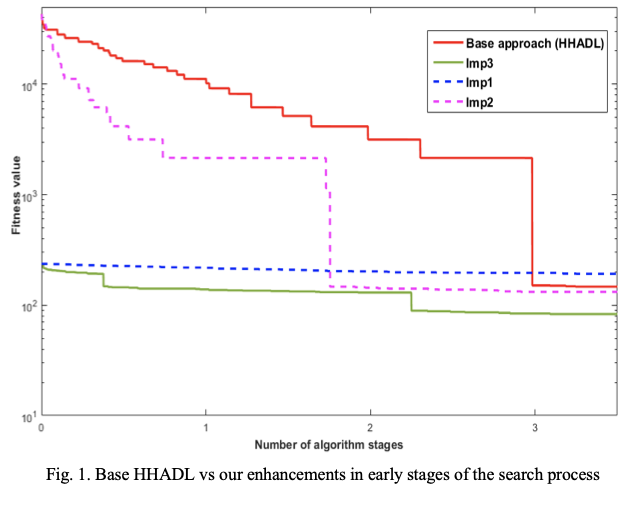
Adaptive Diversifying Hyper-Heuristic Based Approach for Timetabling Problems
Combinatorial optimization is the search for an optimal configuration of a set of variables to accomplish certain goals. One of the well-known combinatorial optimization problems is the timetabling problem, with a lot of research conducted in the past few decades to investigate a variety of methodologies to solve it. One of the blossoming recent methodologies is hyper-heuristics, which attempts to automate the algorithm design process so that it would be able to work with different sets of problem domains. This paper focuses on the university course timetabling problem (UCTP) as the case of

A minimal length uncertainty approach to cosmological constant problem
Based on quantum mechanical framework for the minimal length uncertainty, we demonstrate that the generalized uncertainty principle (GUP) parameter could be best constrained by recent gravitational waves observations on one hand. On the other hand, this suggests modified dispersion relations (MDRs) enabling an estimation for the difference between the group velocity of gravitons and that of photons. Utilizing features of the UV/IR correspondence and the obvious similarities between GUP (including non-gravitating and gravitating impacts on Heisenberg uncertainty principle) and the discrepancy
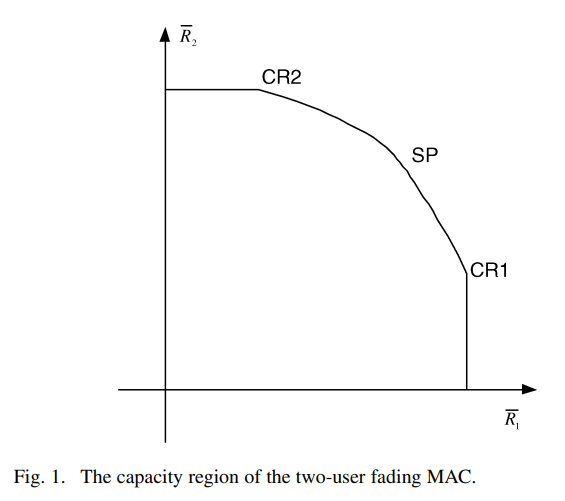
The water-filling game in fading multiple-access channels
A game-theoretic framework is developed to design and analyze the resource allocation algorithms in fading multiple-access channels (MACs), where the users are assumed to be selfish, rational, and limited by average power constraints. The maximum sum-rate point on the boundary of the MAC capacity region is shown to be the unique Nash equilibrium of the corresponding water-filling game. This result sheds a new light on the opportunistic communication principle. The base station is then introduced as a player interested in maximizing a weighted sum of the individual rates. A Stackelberg
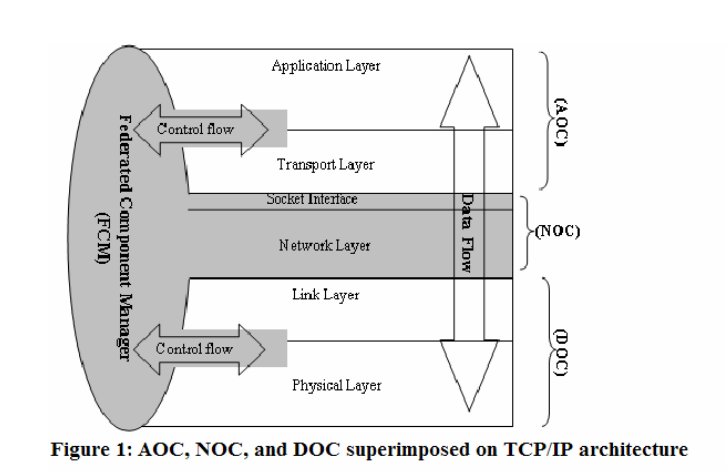
Towards a federated network architecture
The layered architecture that guided the design of the Internet is deemed inadequate as a reference model for engineering protocols for NGN. Layered protocol suites impose a strict sequential order on protocol execution conflicting with the efficient engineering of end systems, as well as failing to express vertical functional integration, the separation of control and data planes, and the distributed nature of network functions. Furthermore, protocols developed according to the layered architecture are implemented as monolithic blocks with undefined or implicit dependencies lacking
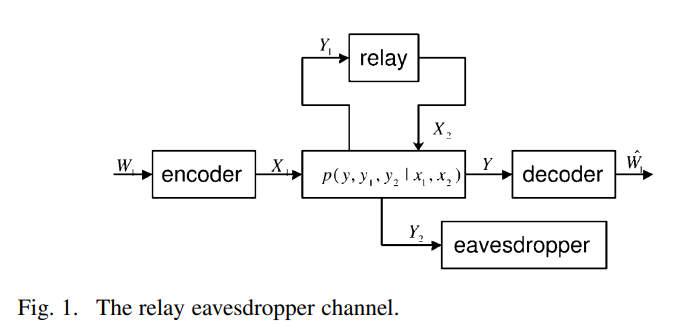
The relay-eavesdropper channel: Cooperation for secrecy
This paper establishes the utility of user cooperation in facilitating secure wireless communications. In particular, the four-terminal relay-eavesdropper channel is introduced and an outer-bound on the optimal rate-equivocation region is derived. Several cooperation strategies are then devised and the corresponding achievable rate-equivocation region are characterized. Of particular interest is the novel noise-forwarding (NF) strategy, where the relay node sends codewords independent of the source message to confuse the eavesdropper. This strategy is used to illustrate the deaf helper
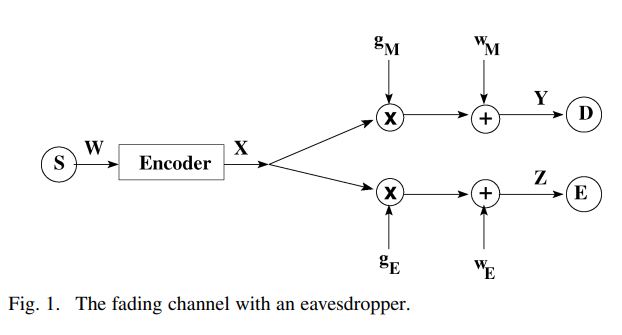
On the secrecy capacity of fading channels
We consider the secure transmission of information over an ergodic fading channel in the presence of an eavesdropper. Our eavesdropper can be viewed as the wireless counterpart of Wyner's wiretapper. The secrecy capacity of such a system is characterized under the assumption of asymptotically long coherence intervals. We first consider the full channel state information (CSI) case, where the transmitter has access to the channel gains of the legitimate receiver and the eavesdropper. The secrecy capacity under this full CSI assumption serves as an upper bound for the secrecy capacity when only
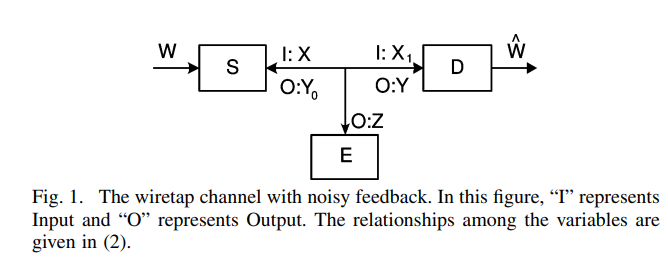
The wiretap channel with feedback: Encryption over the channel
In this work, the critical role of noisy feedback in enhancing the secrecy capacity of the wiretap channel is established. Unlike previous works, where a noiseless public discussion channel is used for feedback, the feed-forward and feedback signals share the same noisy channel in the present model. Quite interestingly, this noisy feedback model is shown to be more advantageous in the current setting. More specifically, the discrete memoryless modulo-additive channel with a full-duplex destination node is considered first, and it is shown that the judicious use of feedback increases the
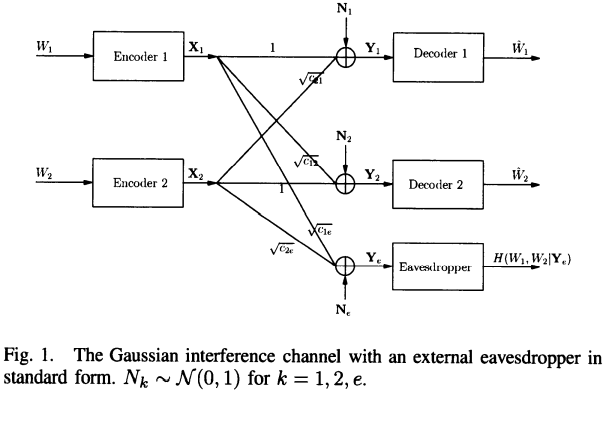
On the secrecy rate region for the interference channel
This paper studies interference channels with security constraints. The existence of an external eavesdropper in a two-user interference channel is assumed, where the network users would like to secure their messages from the external eavesdropper. The cooperative binning and channel prefixing scheme is proposed for this system model which allows users to cooperatively add randomness to the channel in order to degrade the observations of the external eavesdropper. This scheme allows users to add randomness to the channel in two ways: 1) Users cooperate in their design of the binning codebooks
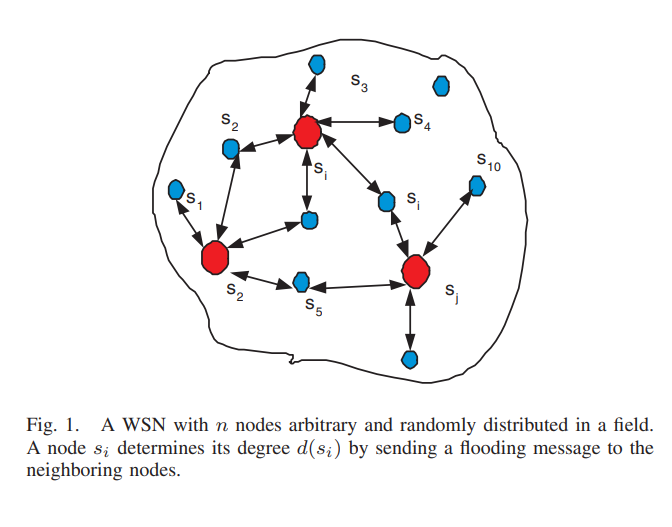
Distributed flooding-based storage algorithms for large-scale wireless sensor networks
In this paper we propose distributed storage algorithms for large-scale wireless sensor networks. Assume a wireless sensor network with n nodes that have limited power, memory, and bandwidth. Each node is capable of both sensing and storing data. Such sensor nodes might disappear from the network due to failures or battery depletion. Hence it is desired to design efficient schemes to collect data from these n nodes. We propose two distributed storage algorithms (DSA's) that utilize network flooding to solve this problem. In the first algorithm, DSA-I, we assume that the total number of sensors