
A dynamic calibration scheme for on-chip process and temperature variations
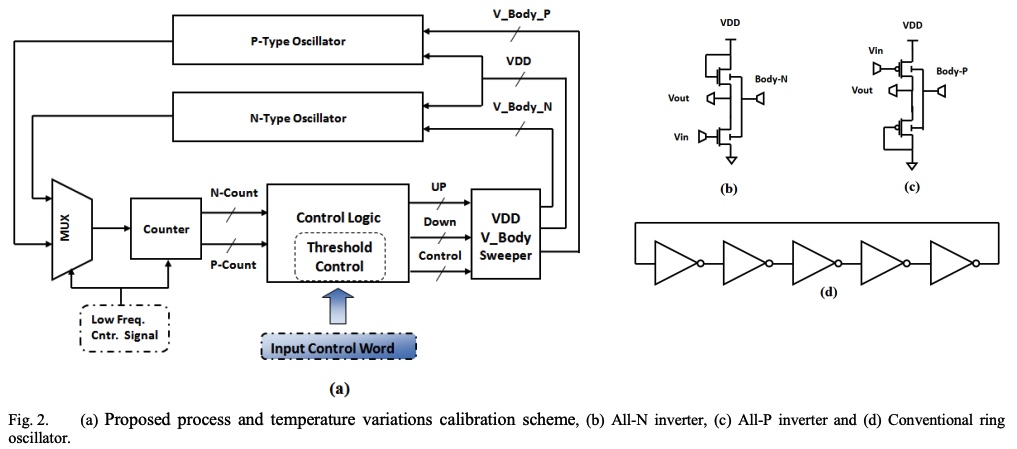
A process and temperature variation calibration scheme is proposed in this paper. The proposed system uses the supply voltage and body bias to calibrate the device parameters to match those of a certain process corner that is determined by the system designer. This scheme is characterized by its ability to dynamically change the desired mapping target according to the computational load. Moreover, the proposed system provides the ability to detect and control the n- and p-type variations independently through the use of an all-n and all-p ring oscillators. The calibration system has been
Resonant square-wave clock generator for low power applications
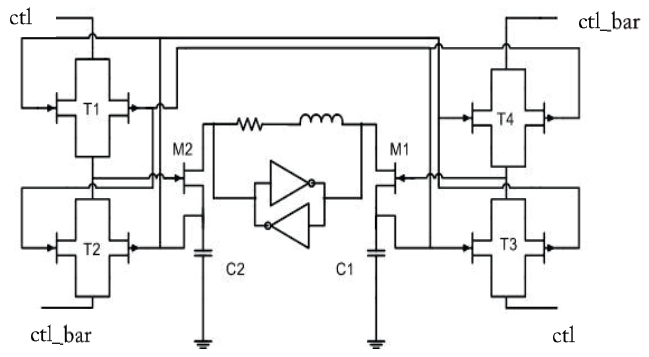
Power reduction is the main challenge facing circuit designers in their quest to utilize the full performance of new process technologies. A major portion of the power consumed in today's systems is due to the clock generation and distribution. Resonant clocking has been a promising technique to reduce the clock power dramatically. In this paper, a novel resonant clock generator circuit is proposed to reduce the dynamic power used for clock generation by almost 75%. Two configurations of the circuit are presented. The merit of this generator is most obvious in the ease of its implementation
Communication—convolution-based estimation of supercapacitor parameters under periodic voltage excitations
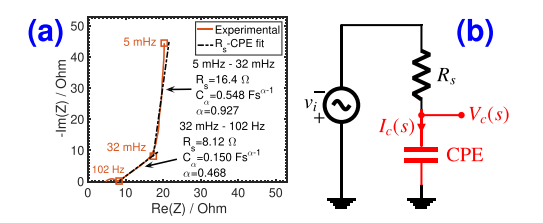
Supercapacitors are typically used in applications requiring frequent and continuous charging/discharging cycles, but most of the models available in the literature are designed to predict their behavior for a single sequence. In this letter, we show first that the electrical response and metrics of supercapacitors under periodic voltage excitations can generally be obtained using Fourier series analysis and convolution operations of functions derived based on any suitable impedance model. We verified our analysis procedure with simulations using particle swarm optimization, and experiments

Communication-The Ragone Plot of Supercapacitors under Different Loading Conditions
The power-energy performance of supercapacitors is usually visualized by the Ragone plot of (gravimetric or volumetric) energy density vs power density. The energy is commonly computed from E = CV2/2, and the power from P = E/Δt, which assume RCbased models. In this study, we investigate the energy-power profiles of two commercial supercapacitors discharged with three different types of loads: (i) constant current, (ii) constant power, and (iii) constant resistive load. The energy is computed as per the definition from the time-integral of its instantaneous power, i.e. E(t) = ò p(t)dt with p(t

Investigation of properties limiting efficiency in Cu2ZnSnSe4-based solar cells
We have investigated different nonidealities in Cu2ZnSnSe4-CdS-ZnO solar cells with 9.7% conversion efficiency, in order to determine what is limiting the efficiency of these devices. Several nonidealities could be observed. A barrier of about 300 meV is present for electron flow at the absorber-buffer heterojunction leading to a strong crossover behavior between dark and illuminated current-voltage curves. In addition, a barrier of about 130 meV is present at the Mo-absorber contact, which could be reduced to 15 meV by inclusion of a TiN interlayer. Admittance spectroscopy results on the
Hierarchical proactive caching for vehicular ad hoc networks
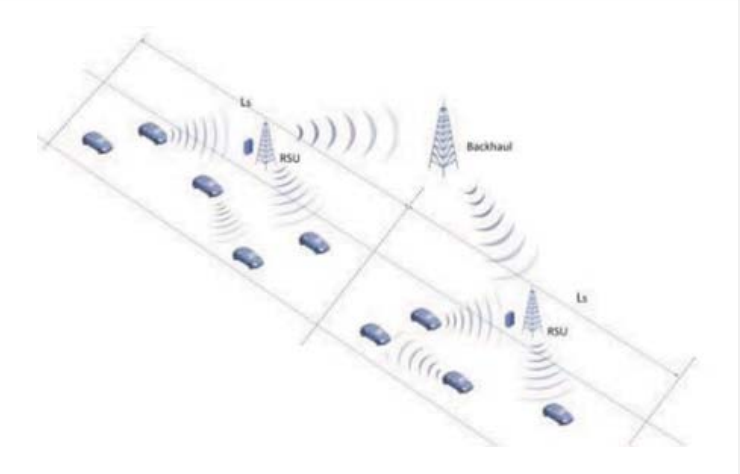
Recently, emerging vehicular applications are increasing the demand of vehicles which form significant burdens on network backhaul and represents a cause to the quality of experience (QoE) decay of the vehicular users. Proactive caching is a promising technique to mitigate the load on core networks by caching some of the expected data items. This work proposes a hierarchical proactive caching scheme which jointly considers caching in vehicles and roadside units (RSUs). Minimization of the vehicle communication latency is the main objective of our study. The optimization problem is formulated
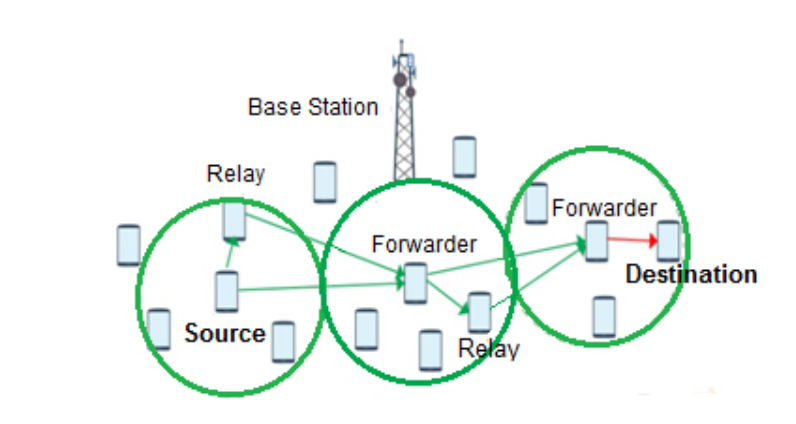
Geographic Routing with Cooperation for Reliable Paths in Device-to-Device Networks
In this paper, we introduce a novel geographic routing with cooperation scheme for 5G Device-to-Device ad hoc networks. The prime focus of our scheme (coined Cooperative Routing for Reliable Paths (CRRP)) is to enhance the routing performance in cooperative communication networks in terms of the path length and reliability. In particular, it introduces novel algorithms for cooperative relay and forwarder selections, which strike the best balance between path length and achieved symbol error rate, compared to prior work in the literature. Moreover, it exhibits the flexibility of deciding
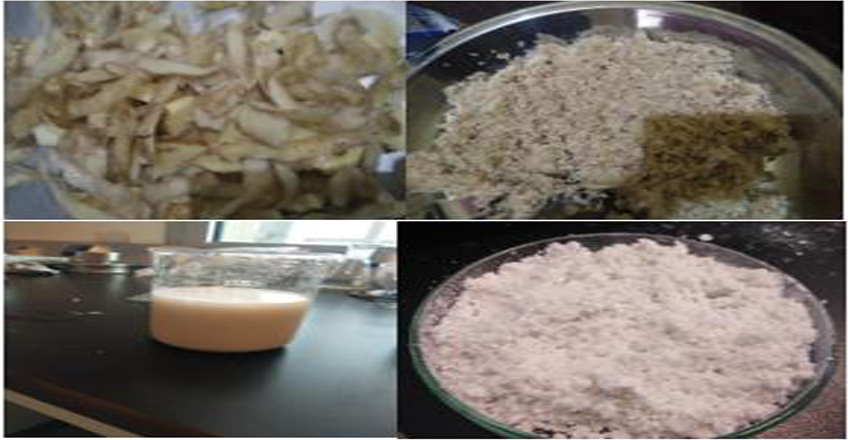
Fabrication of bio-plastic composite pellets from agricultural waste and food waste
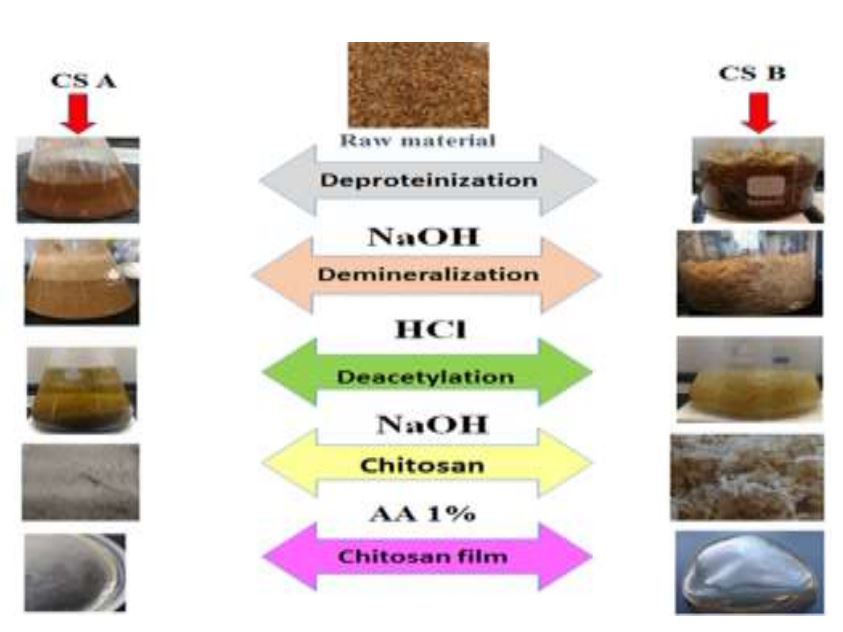
Extraction of degradable bio polymer materials from shrimp shell wastes by two different methods
Chitosan is one of the most widespread biopolymer materials available in nature which is extracted from chitin. The main source of chitosan is the chitin that is extracted from exoskeletons of crustacean, such as shrimp and crabs, which are found in a huge amount of shells waste that produced from seafood companies around the world. The chitosan has several applications such as pharmaceutical, fertilizer and edible coating in food industries. The quality of the chitosan's depends on its extraction method, so in this research work we have studied the effect of grounding shrimp shell waste
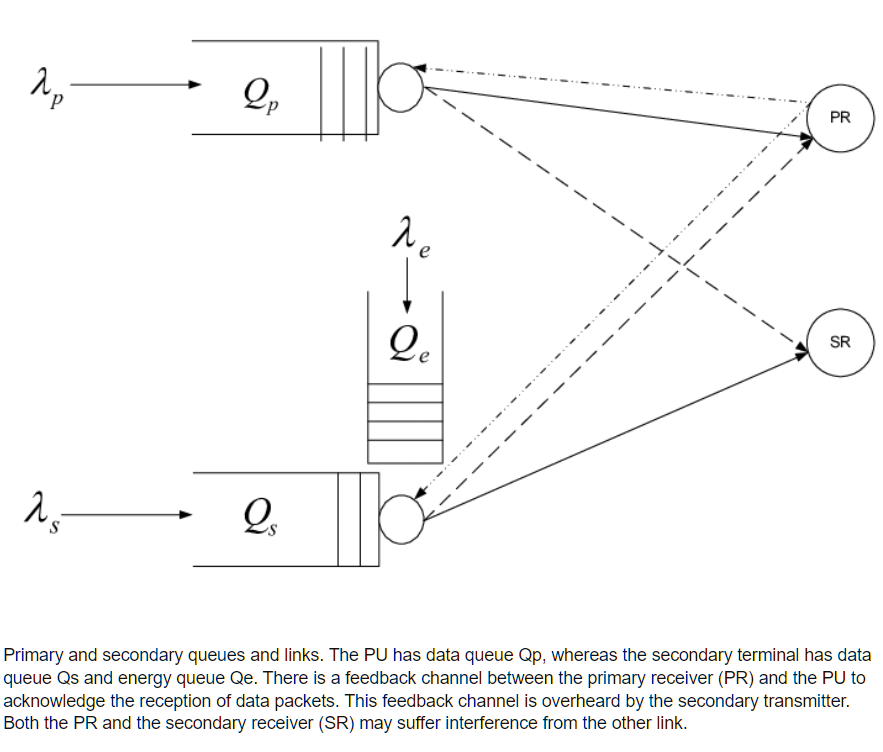
Optimal random access and random spectrum sensing for an energy harvesting cognitive radio
We consider a secondary user with energy harvesting capability. We design access schemes for the secondary user which incorporate random spectrum sensing and random access, and which make use of the primary automatic repeat request (ARQ) feedback. The sensing and access probabilities are obtained such that the secondary throughput is maximized under the constraints that both the primary and secondary queues are stable and that the primary queueing delay is kept lower than a specified value needed to guarantee a certain quality of service (QoS) for the primary user. We consider spectrum sensing