
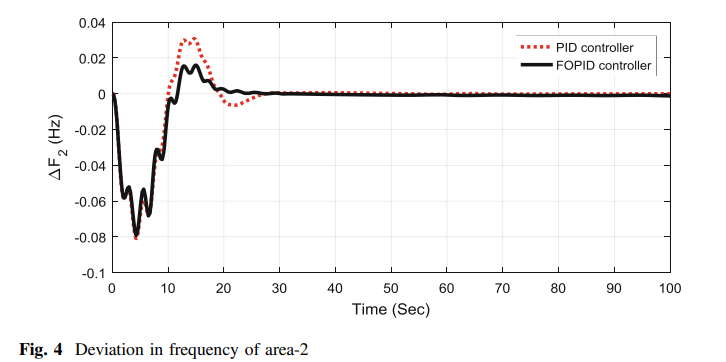
TLBO algorithm optimized fractional-order PID controller for AGC of interconnected power system
The present study focuses on the problem of automatic generation control (AGC) by employing the design of fractional-order proportional–integral– derivative controller (FOPID). A hydrothermal power system with governor dead band (GDB) and generation rate constraint (GRC) is considered for investigation. FOPID controller optimal values are obtained by using teacher learning-based optimization (TLBO) technique, and the employed objective function is integral time-multiplied absolute error (ITAE). The supremacy of the proposed controller is also shown by comparing with PID controller. Further
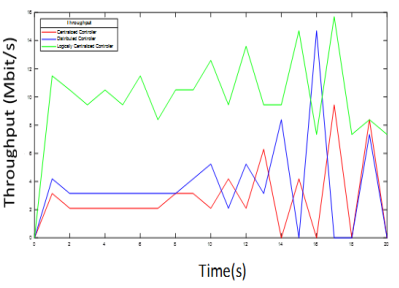
Software Defined Network Based Management Framework for Wireless Sensor Networks
Wireless Sensor Network (WSN) has growth rapidly over the past years. As it is now applied in many fields as in health care systems, home automation, security surveillance, disaster management and more. Due to the high demand on WSN, it is important to find a solution for one of the major challenges in WSN which is the energy consumption of its battery operated sensor device. So in this paper we propose to use Software Defined technology into WSN to enhance network management and to prolong network lifetime. As the main feature of Software Defined Network (SDN) is the centralization of control
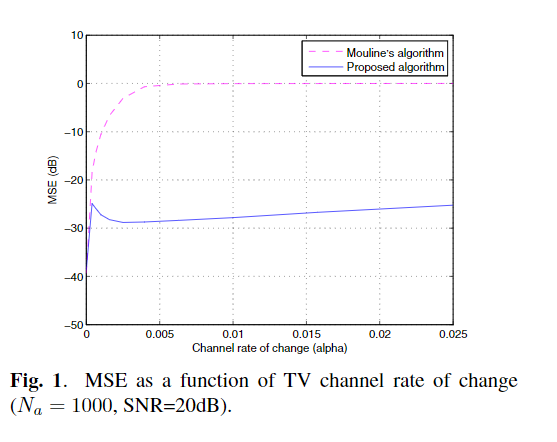
A subspace method for the blind identification of multiple time-varying FIR channels
A new method is proposed for the blind subspace-based identification of the coefficients of time-varying (TV) single-input multiple-output (SIMO) FIR channels. The TV channel coefficients are represented via a finite basis expansion model, i.e. linear combination of known basis functions. In contrast to earlier related works, the basis functions need not be limited to complex exponentials, and therefore do not necessitate the a priori estimation of frequency parameters. This considerably simplifies the implementation of the proposed method and provides added flexibility in applications. The
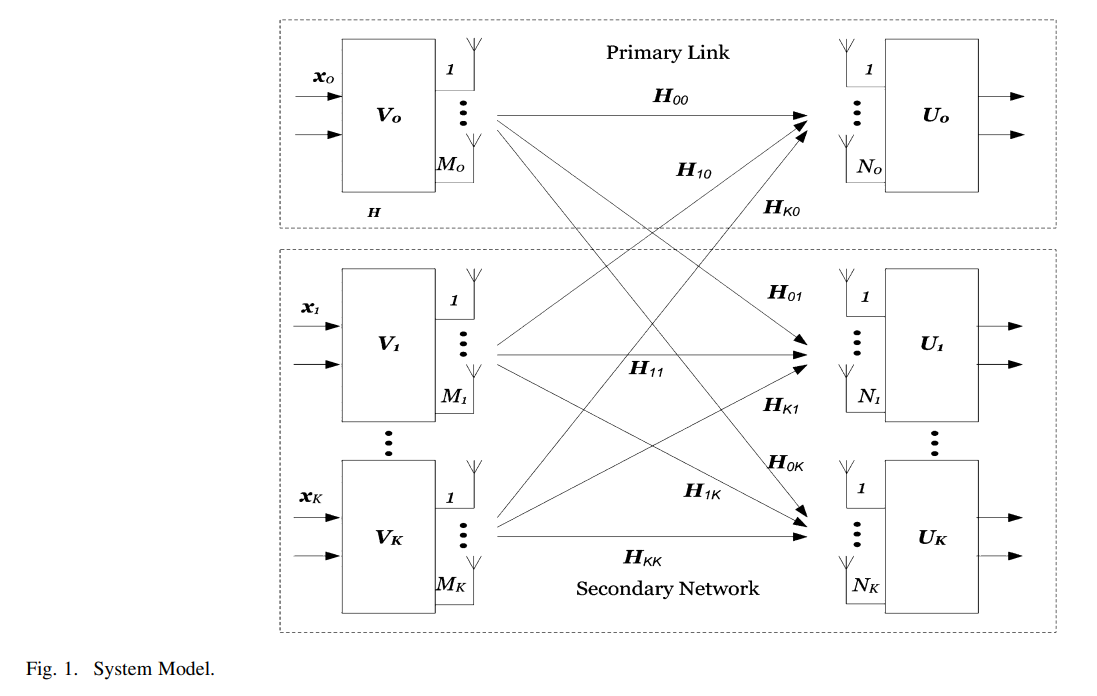
Constrained interference alignment and the spatial degrees of freedom of mimo cognitive networks
An interference alignment (IA) scheme is presented that allows multiple opportunistic transmitters (secondary users) to use the same frequency band of a pre-existing primary link without generating any interference. The primary and secondary transmit-receive pairs are equipped with multiple antennas. Under power constraints on the primary transmitter, the rate of the primary user is maximized by water-filling on the singular values of its channel matrix leaving some eigen modes unused, and hence, the secondary users can align their transmitted signals to produce a number of interference-free
Optimizing Cooperative Cognitive Radio Networks Performance with Primary QoS Provisioning
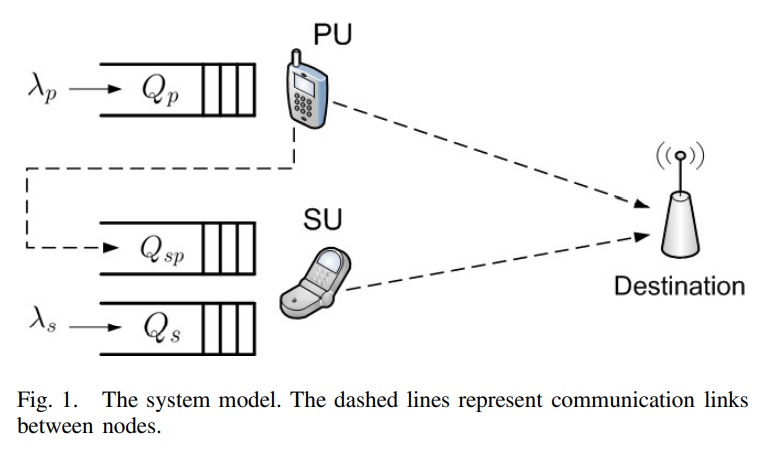
We consider the problem of optimizing the performance of a cooperative cognitive radio user subject to constraints on the quality-of-service (QoS) of the primary user (PU). In particular, we design the probabilistic admission control parameter of the PU packets in the secondary user (SU) relaying queue and the randomized service parameter at the SU under non-work-conserving (non-WC) and WC cooperation policies. In the non-WC policy, two constrained optimization problems are formulated; the first problem is maximizing the SU throughput while the second problem is minimizing the SU average delay
Maximum throughput of a secondary user cooperating with an energy-aware primary user
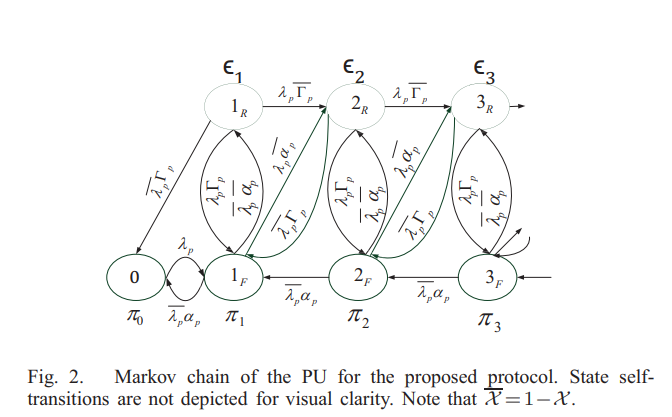
This paper proposes a cooperation protocol between a secondary user (SU) and a primary user (PU) which dedicates a free frequency subband for the SU if cooperation results in energy saving. Time is slotted and users are equipped with buffers. Under the proposed protocol, the PU releases portion of its bandwidth for secondary transmission. Moreover, it assigns a portion of the time slot duration for the SU to relay primary packets and achieve a higher successful packet reception probability at the primary receiver. We assume that the PU has three states: idle, forward, and retransmission states
Maximum throughput opportunistic network coding in Two-Way Relay networks
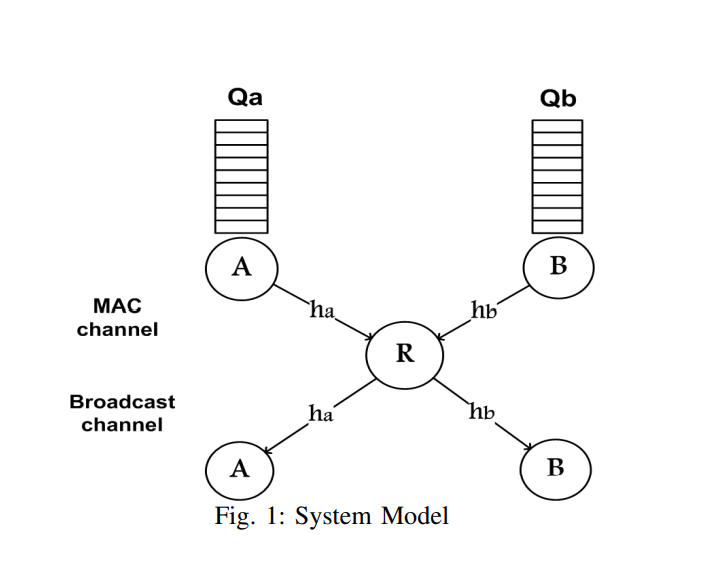
In this paper, we study Two-Way Relaying (TWR) networks well-known for its throughput merits. In particular, we study the fundamental throughput delay trade-off in TWR networks using opportunistic network coding (ONC). We characterize the optimal ONC policy that maximizes the aggregate network throughput subject to an average packet delay constraint. Towards this objective, first, we consider a pair of nodes communicating through a common relay and develop a two dimensional Markov chain model capturing the buffers' length states at the two nodes. Second, we formulate an optimization problem
Optimized Preliminary Design of a Multistage Low-Speed Axial FLow Compressor
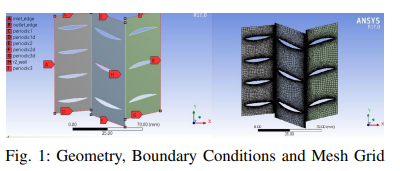
This paper proposes a technique based on a MAT-LAB code capable of getting an optimized preliminary design of an efficient low-speed compressor qualified for laboratory experiments with relatively low cost. The code was made to design five repeated compressor stages on two steps conducted iteratively, namely 'mean line and radial design' to determine the optimum compressor geometry and then the 'off-design' to test the stability of the design in other working conditions. The optimization tool minimizes a flexible cost function which can be changed if needed to get different designs. A certain

Validation of the Nonlinear Superposition Method (NSM) for elastic shakedown limit pressures via comparison with experimental test results of spherical vessels with radial and oblique nozzles
The present research revisits rare experiments which determined elastic shakedown (SD) limit pressures of full scale radial and oblique nozzles partially penetrating spherical vessels. The experiments were conducted at Berkeley Nuclear Laboratories in England [1]. The SD limit pressures were determined via conducting consecutive series of internal pressure cycles and observing cyclic strain variation recorded by strain gauges cemented at predetermined various critical locations within the junctions’ vicinities. The Nonlinear Superposition Method (NSM), formulated for computing elastic SD limit
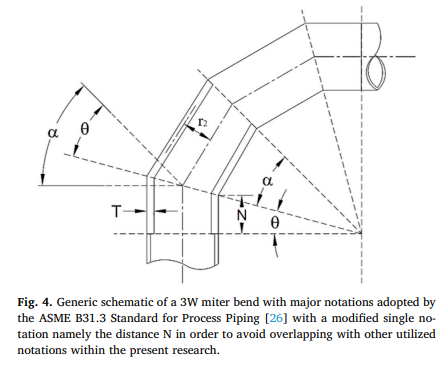
Load carrying capacities of pressurized 90 degree miter and smooth bends subjected to monotonic in-plane and out-of-plane bending loadings
The present research focuses on generating interaction diagrams (i.e. limit moment boundaries vs steady internal pressure spectra) of pressurized 90 o miter and smooth bends. One-, two-, three-, and four-weld miter bends are modelled and analyzed. Additionally, 90 o smooth bends (SBs) bearing the miter bends’ same material and major geometric parameters are analyzed thus providing broader range of comparisons concerning structural responses to external applied loadings. All bends analyzed are subjected to steady internal pressure spectra and monotonic in-plane closing, in-plane opening, and