
Machine Learning-based Module for Monitoring LTE/WiFi Coexistence Networks Dynamics
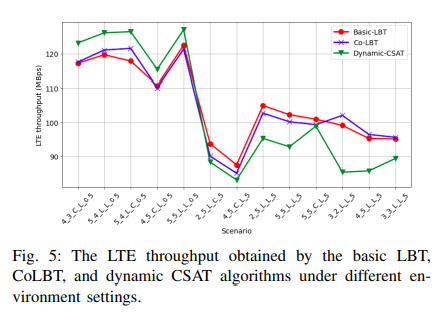
Long-Term Evolution (LTE) technology is expected to shift some of its transmissions into the unlicensed band to overcome the spectrum scarcity problem. Nevertheless, in order to effectively use the unlicensed spectrum, several challenges have to be addressed. The most important of which is how to coexist with the incumbent unlicensed WiFi networks. Incorporating the "intelligence"component into the network radios is foreseen to resolve the intrinsic network challenges, rather than conventional non-adaptive action plans. Specifically, an intelligent cognitive engine (CE) that continuously
Double Fractional-order Masks Image Enhancement
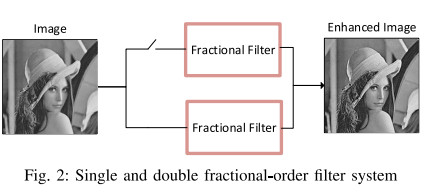
Image enhancement is better achieved when fractional-order masks are used rather than integer-order ones, this is due to the flexibility of fractional-order parameters control. This paper proposes a combination of fractional-order masks to be used in parallel as double filters system structure to improve image enhancement rather than using a single-stage filter. Various performance metrics are used in this work to evaluate the proposed system, such as Information Entropy (IE), Average Gradient (AG), Structural Similarity Index Metric (SSIM) and Peak Signal to Noise Ratio (PSNR). Based on
Impact of dynamic capacity policies on WIP level in mix leveling lean environment
Balancing demand's product variety in production planning is one aspect of variety management challenge. This phenomenon is described in lean systems as mix leveling. This paper approach product mix leveling problem from a dynamic perspective. A system dynamics model is developed to explore the dynamics associated with the WIP level performance at different mix leveling policies in a lean environment. The system captures different lean tools and policies. Results showed that the best WIP performance is sensitive to both the degree of lean tools implementation as well as the capacity
Impact of dynamic capacity policies on WIP level in mix leveling lean environment
Balancing demand's product variety in production planning is one aspect of variety management challenge. This phenomenon is described in lean systems as mix leveling. This paper approach product mix leveling problem from a dynamic perspective. A system dynamics model is developed to explore the dynamics associated with the WIP level performance at different mix leveling policies in a lean environment. The system captures different lean tools and policies. Results showed that the best WIP performance is sensitive to both the degree of lean tools implementation as well as the capacity
Dynamic lean assessment for takt time implementation
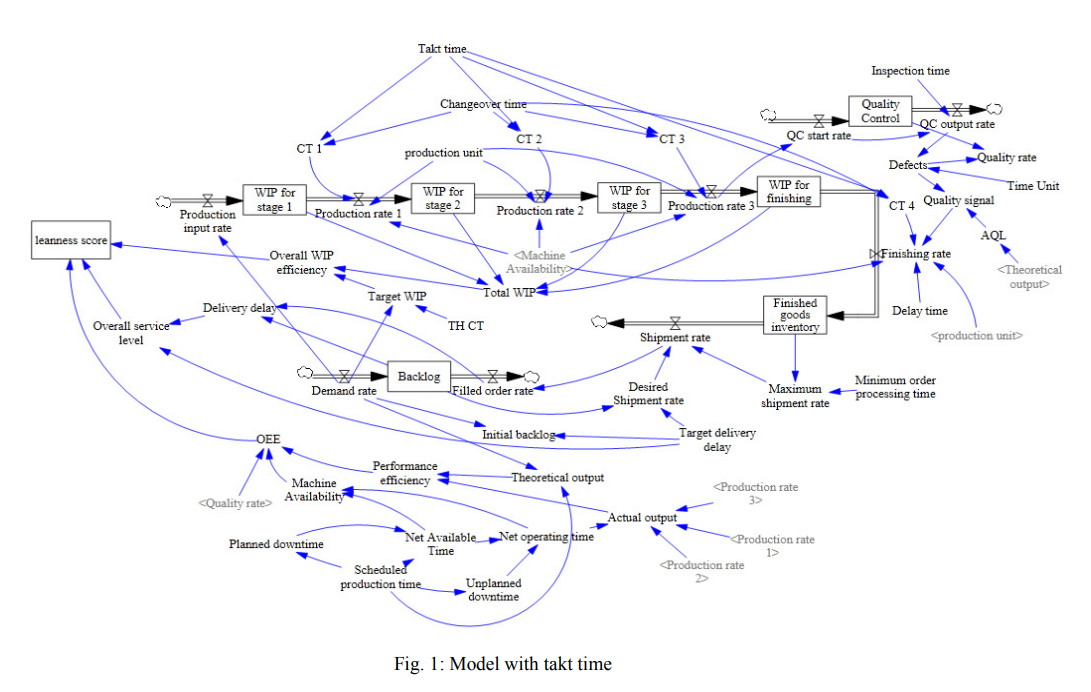
Increasing volatility global competitiveness and sales crisis all force the manufacturers to commit to the journey of world-class manufacturing performance via adopting "lean systems" to enable economic success in difficult times Among the journey to lean one of the hardest steps is measuring the progress of lean polices implementation especially in this highly dynamic market This' paper presents a dynamic model to evaluate the degree of leanness in manufacturing firms The model is based on system dynamics approach and presents a "leanness score" for the manufacturing system. In addition, it
An Intelligent Geographical Information System for Vehicle Routing (IGIS-VR): A modeling framework
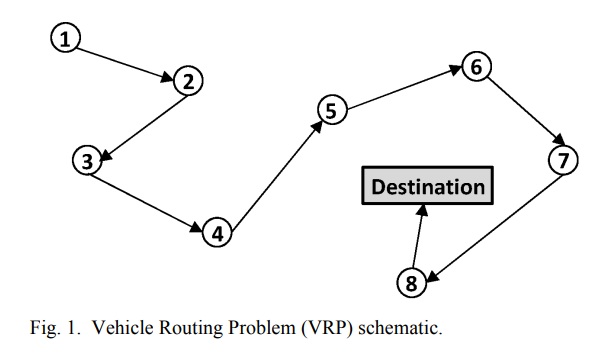
In Egypt, freight movement relies heavily on road transport. Commercial vehicles constitute a major segment of the vehicle population that travels the country's roads contributing to (and suffering from) daily congestion. Enhancing CV operations by minimizing their en-route travel times benefits both traffic network users as well as CV's business owners. The absence of traffic data collection infrastructure, in many developing countries, hampers the usage of readily available vehicle routing systems. This paper introduces a modeling framework of an Intelligent Geographical Information System
A Bilevel Traffic Data Extraction Procedure via Cellular Phone Network for Intercity Travel
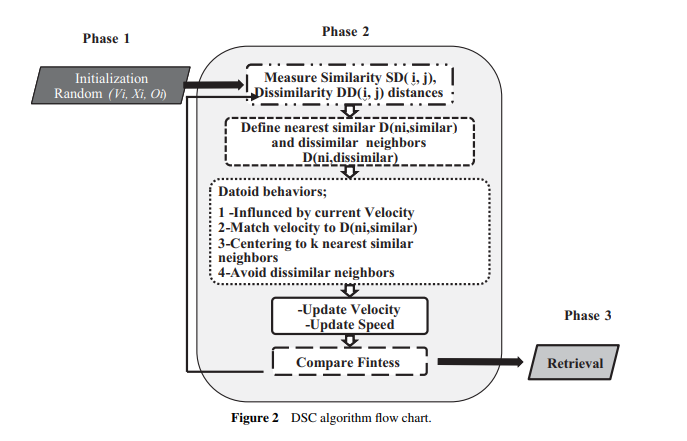
The absence of traffic surveillance infrastructure, in many developing countries, hinders any efforts for dealing with the daily witnessed traffic chaos. The use of the cellular phone (CP) network data for traffic data collection is a promising option for large-scale coverage, given a high CP penetration rate. This article presents a bilevel procedure for the extraction of classified vehicular traffic counts for different vehicle types, in a given roadway segment, for intercity travel. The bilevel procedure operates in an offline setting, independent from any secondary traffic surveillance
Smart devices for smart environments: Device-free passive detection in real environments
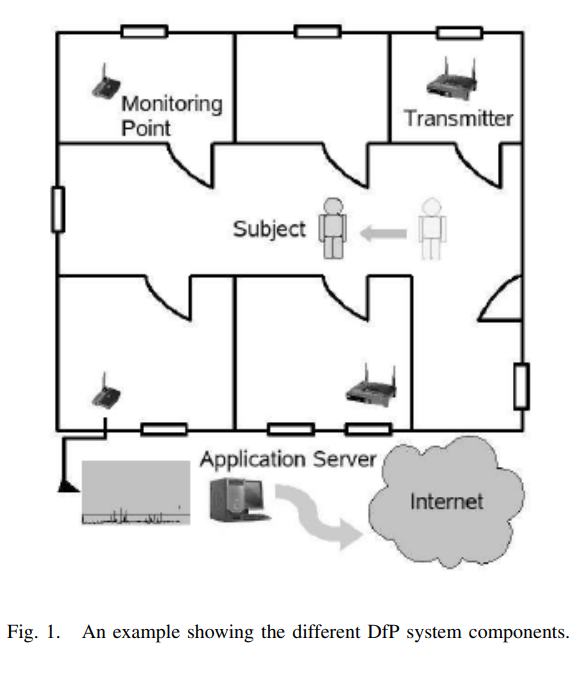
Device-free Passive (DfP) localization is a system envisioned to detect, track, and identify entities that do not carry any device, nor participate actively in the localization process. A DfP system allows using nominal WiFi equipment for intrusion detection, without using any extra hardware, adding smartness to any WiFi-enabled device. In this paper, we focus on the detection function of the DfP system in a real environment. We show that the performance of our previously developed algorithms for detection in a controlled environments, which achieved 100% recall and precision, degrades
The MIMO wireless switch: Relaying can increase the multiplexing gain
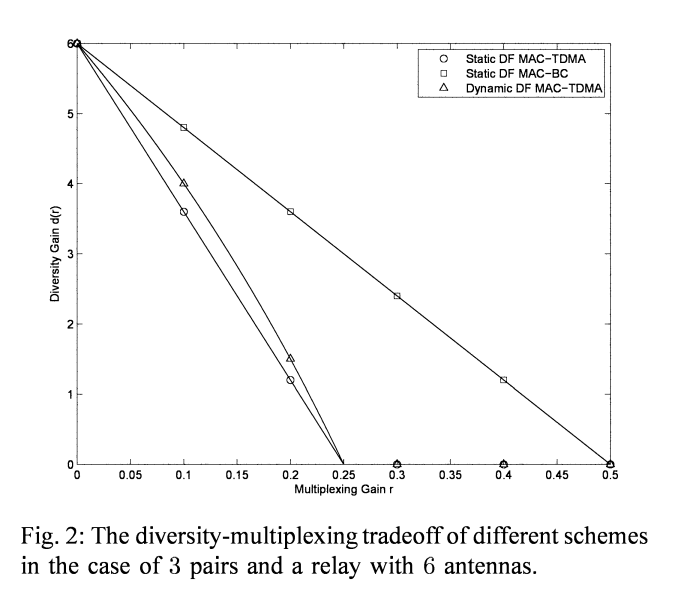
This paper considers an interference network composed of K half-duplex single-antenna pairs of users who wish to establish bi-directional communication with the aid of a multiinput-multi-output (MIMO) half-duplex relay node. This channel is referred to as the "MIMO Wireless Switch" since, for the sake of simplicity, our model assumes no direct link between the two end nodes of each pair implying that all communication must go through the relay node (i.e., the MIMO switch). Assuming a delay-limited scenario, the fundamental limits in the high signal-to-noise ratio (SNR) regime is analyzed using
Randomization for security in half-duplex two-way Gaussian channels
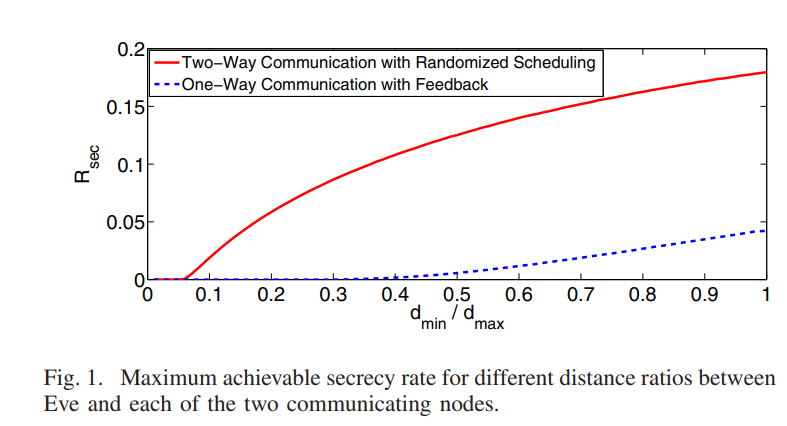
This paper develops a new physical layer framework for secure two-way wireless communication in the presence of a passive eavesdropper, i.e., Eve. Our approach achieves perfect information theoretic secrecy via a novel randomized scheduling and power allocation scheme. The key idea is to allow Alice and. Bob to send symbols at random time instants. While Alice will be able to determine the symbols transmitted by Bob, Eve will suffer from ambiguity regarding the source of any particular symbol. This desirable ambiguity is enhanced, in our approach, by randomizing the transmit power level. Our